

Next.js admin panelAdd a content and admin layer to your Next.js app.
Runs inside your own Next.js app, on your own PostgreSQL or MySQL database, or SQLite for local work.
Read content straight from your database in your page code (the Direct API), or over REST.
Sign-in for your team: email and password, sessions and API keys, stored in your own database.
npx create-nextly-app@alpha my-app01How it fits together
What you write, what Nextly runs, and who it is for
Each numbered part is explained under the drawing, with its limit where it has one.
Your Next.js app
- In your code
nextly.config.tsCollections, singles, rulesNextly, inside your Next.js appThe adminAt /adminWho it is forYour team: entries, media, users - In your code
app/**/page.tsxYour routes and server codeNextly, inside your Next.js appThe Direct APITrusted server codeWho it is forYour pages and routes - Nextly, inside your Next.js appRESTUnder /admin/api, with API keysWho it is forOther apps and services
- In your code
collections/*.tsHooks in your collection configNextly, inside your Next.js appHooksRun when content changesWho it is forYour code - In your codeSet in the adminNextly, inside your Next.js appWebhooksSigned, with retriesWho it is forYour services
Your own PostgreSQL or MySQL database, or SQLite for local work
The admin
Model content in TypeScript or in the Visual Schema Builder. Both feed the same Nextly runtime, admin and APIs.
Role-based permissions for each collection and action, plus field-level read and write rules in code, on a collection’s or single’s own fields.
CMS for Next.jsThe Direct API
Read content straight from your database in your page code (the Direct API), or over REST.
LimitThe Direct API runs as trusted server code and skips access rules unless you pass
CMS for Next.jsoverrideAccess: false.REST
Access rules you write in code apply over REST and in the admin, including read rules on a collection’s or single’s own fields.
LimitWith the rate limit on (the default), every REST request, the admin API included, counts against a budget for whoever is asking: a signed-in session, an API key, or an address.
CMS for Next.jsWebhooks
Signed webhooks for content, media, user and form events, with retries, a delivery log, redelivery and secret rotation.
CMS for Next.js
02Who does what
Who does what
Your code
- 01
Create the project
One command creates a project with the admin and a database:
npx create-nextly-app@alpha my-app. - 02
Define the content
Typed, code-defined schemas and APIs:
nextly generate:typeswrites types for the collections, singles and field groups in your config. - 03
Read it in your routes
Read content straight from your database in your page code (the Direct API), or over REST.
HandoverSign-in for your team: email and password, sessions and API keys, stored in your own database.
The admin
- 04
Create the first admin
In production, the web setup asks for a one-time setup token, printed in the server log, before it creates the first admin.
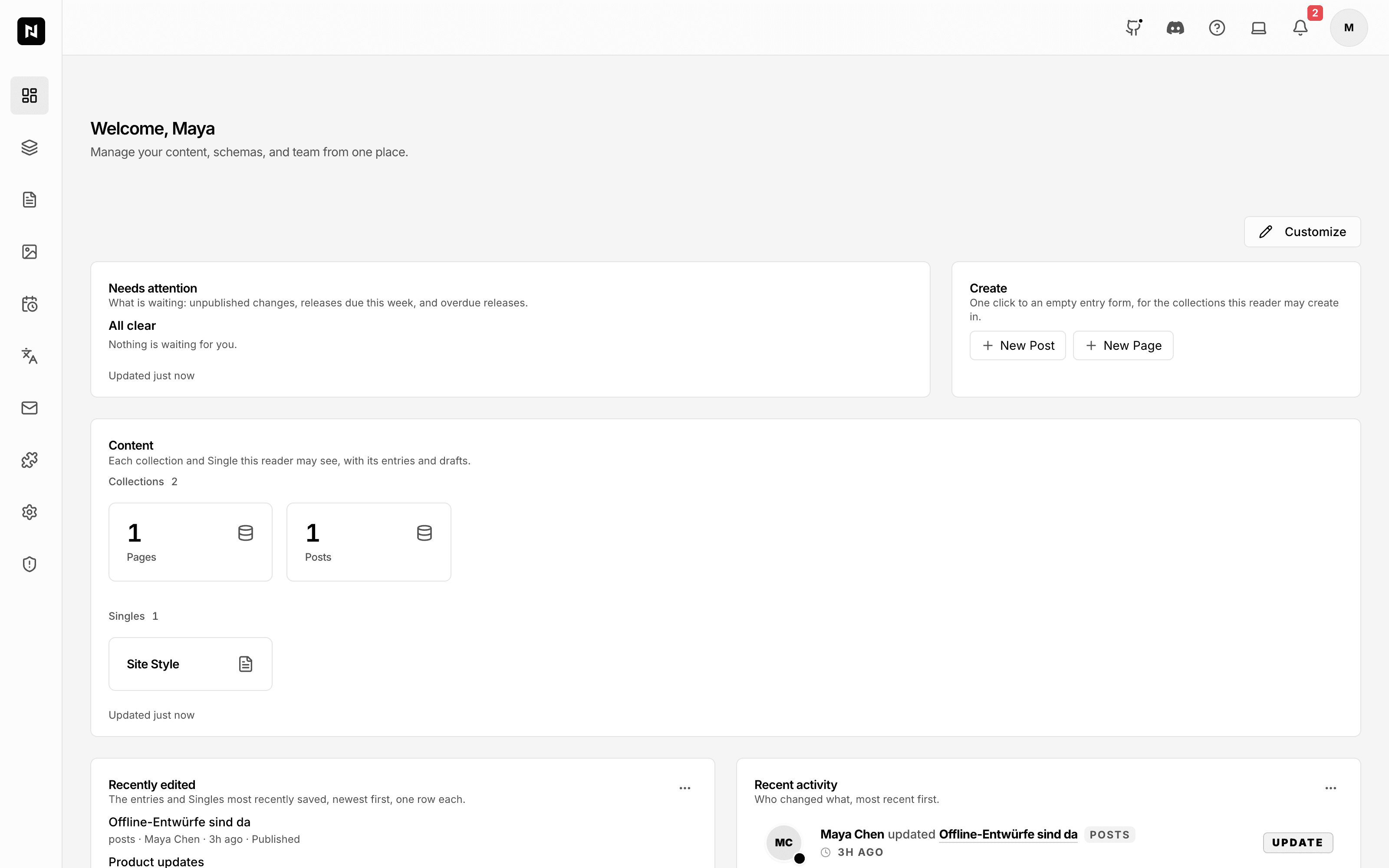
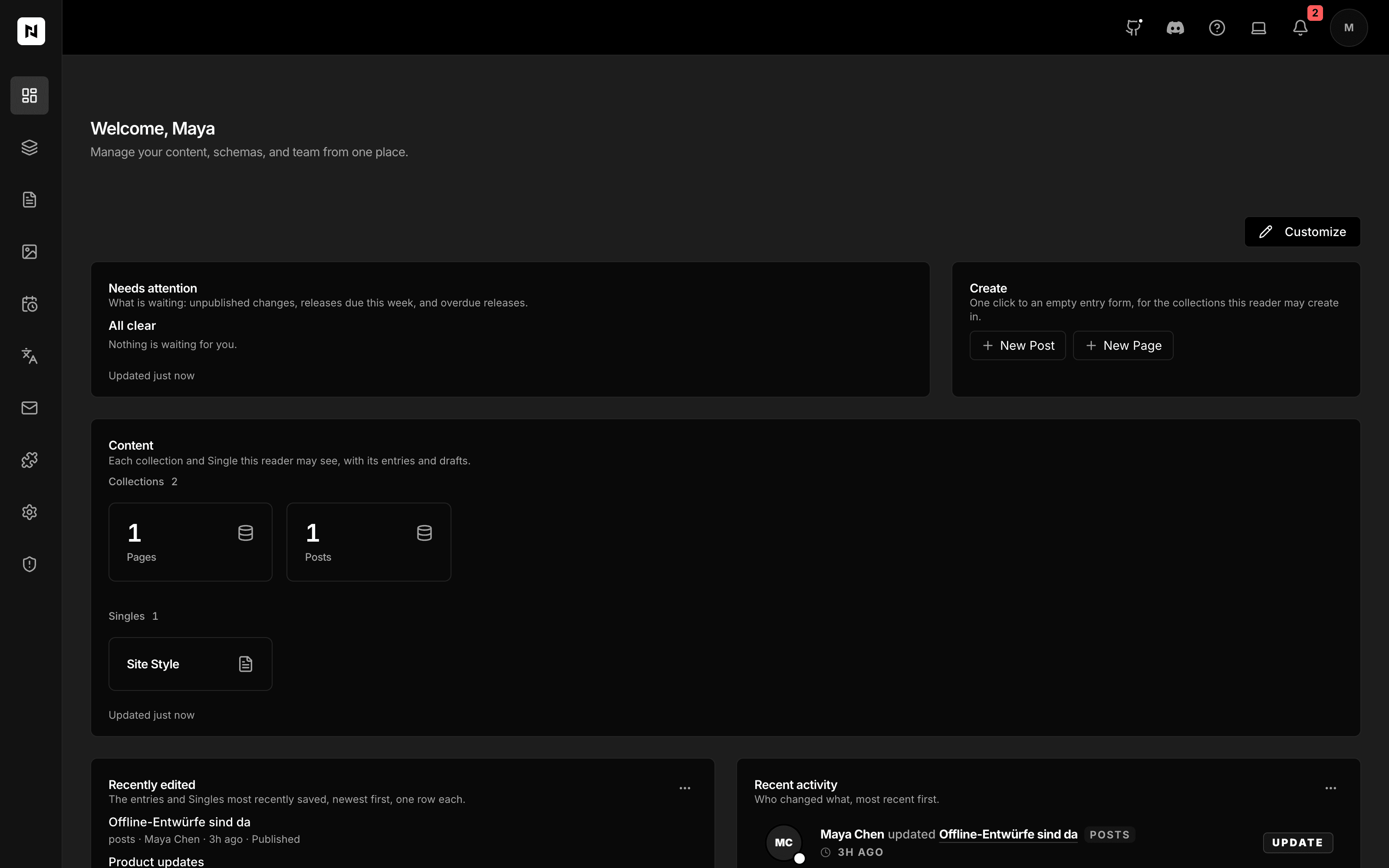
The dashboard, with its collection counts and create buttons. Nextly admin · 0.0.2-alpha.69
- 05
Manage the content
A media library, stored on local disk by default, or on S3 (and R2 or MinIO), Vercel Blob or UploadThing.
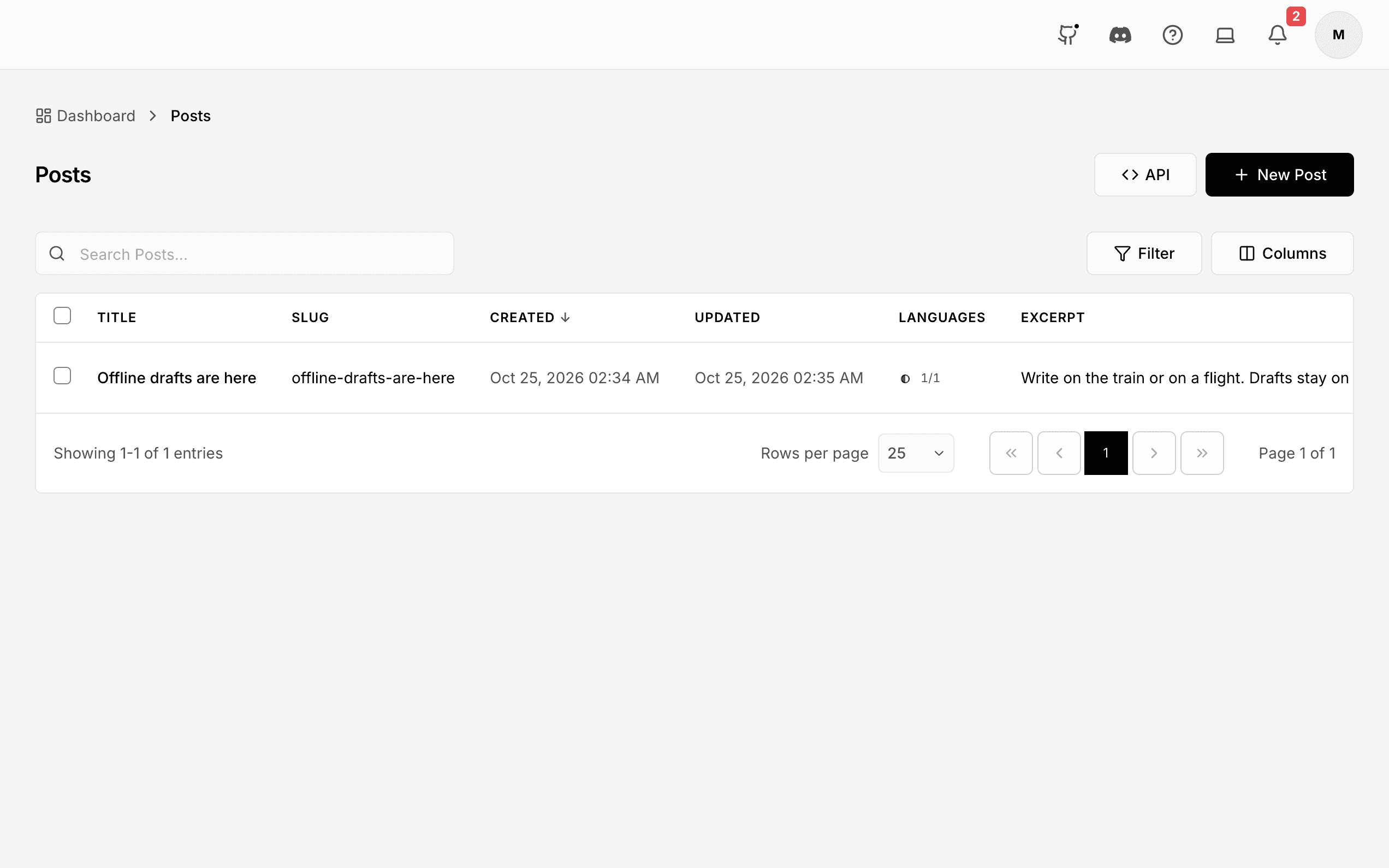
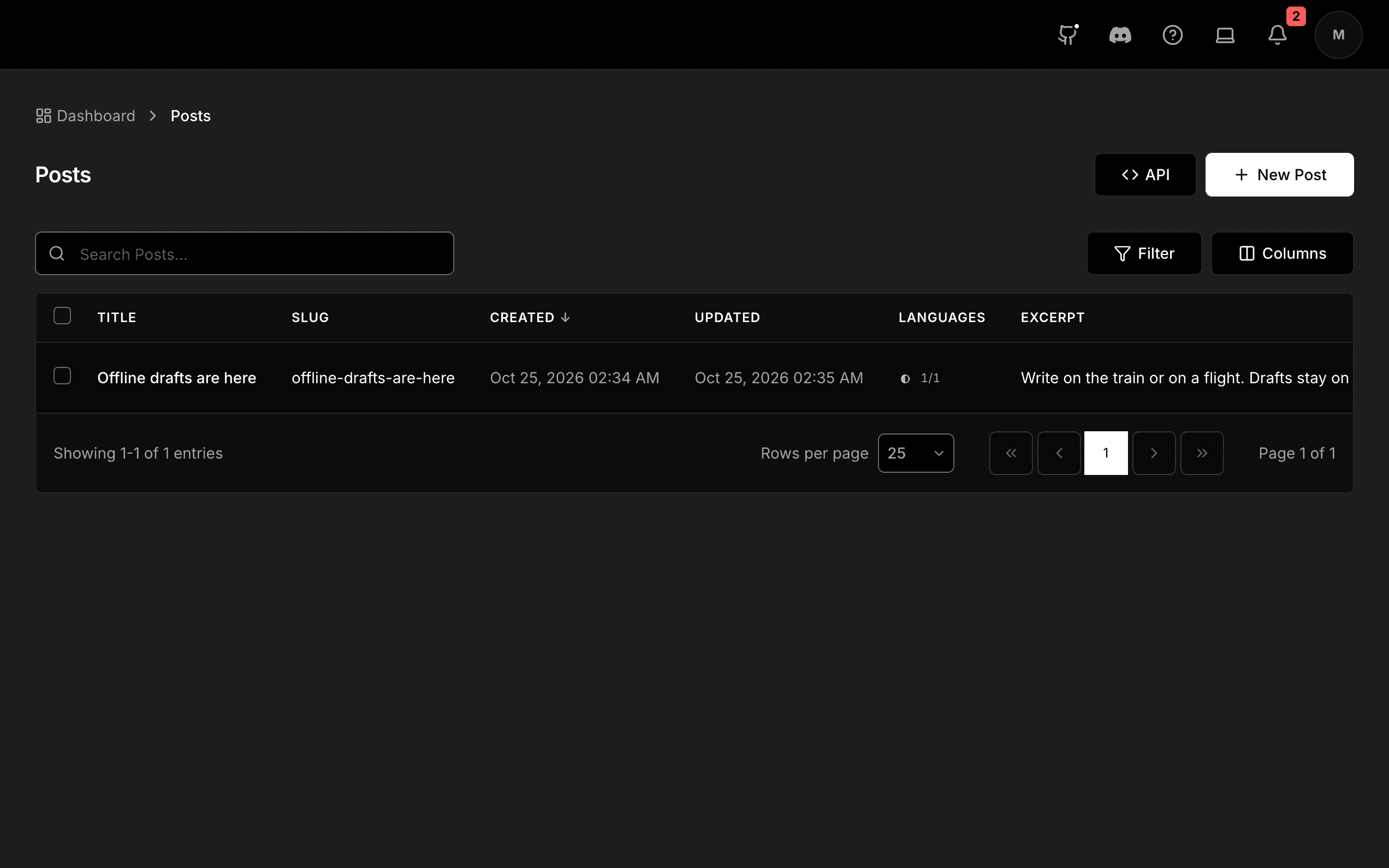
The Posts list, with search, filters and its API button. Nextly admin · 0.0.2-alpha.69
- 06
See who changed what
An activity feed of who created, changed or deleted entries, and a security audit trail.
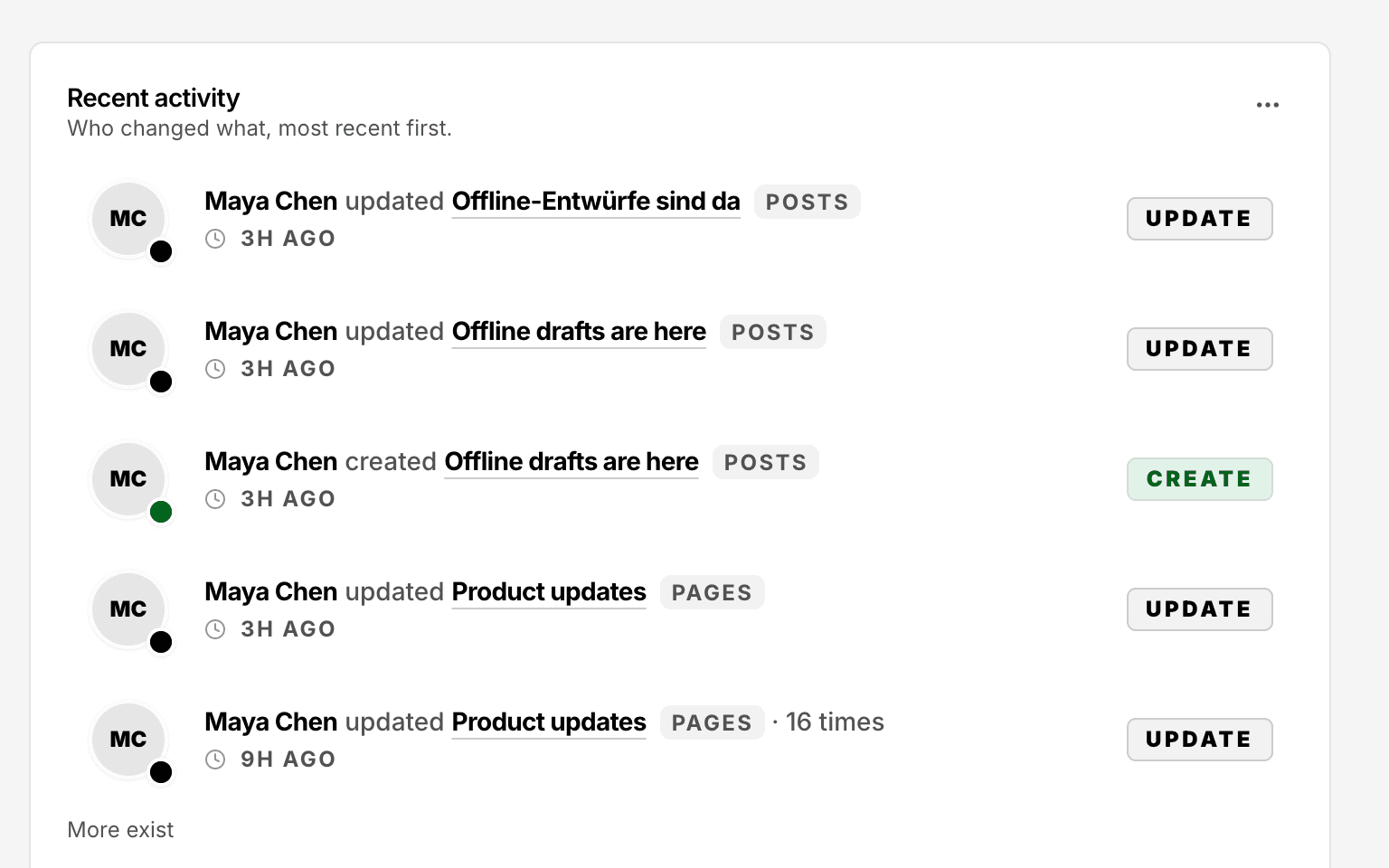
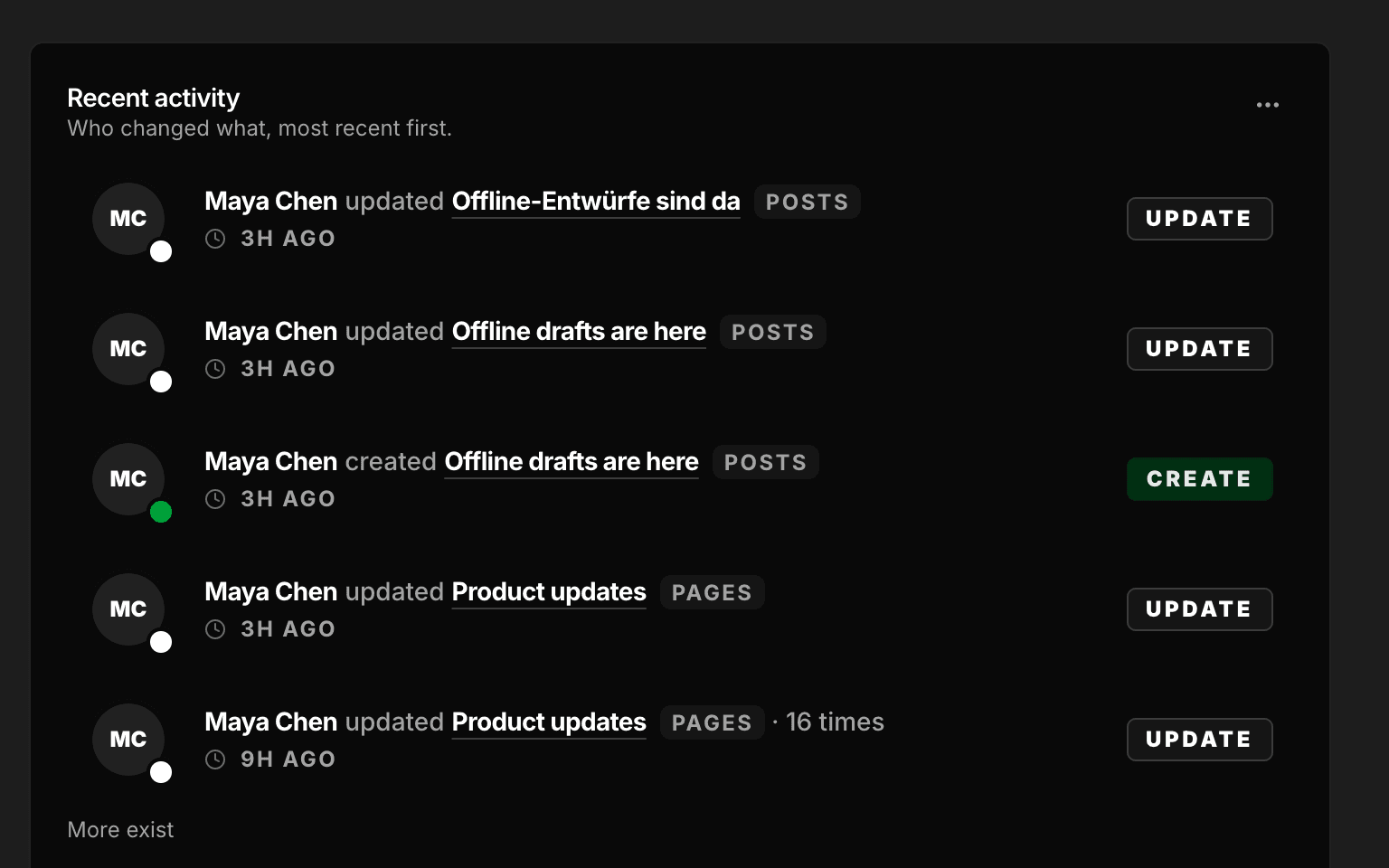
The recent activity feed on the dashboard. Nextly admin · 0.0.2-alpha.69
03The parts
What you use, and where it comes from
In 0.0.2-alpha.70
| Part | What it does | Package | The parts of Nextly this uses |
|---|---|---|---|
| Content model | Model content in TypeScript or in the Visual Schema Builder. Both feed the same Nextly runtime, admin and APIs. | nextly | CMS for Next.js |
| Roles and field rules | Role-based permissions for each collection and action, plus field-level read and write rules in code, on a collection’s or single’s own fields. | nextly | CMS for Next.js |
| Team sign-in | Sign-in for your team: email and password, sessions and API keys, stored in your own database. | nextly | CMS for Next.js |
| Media | A media library, stored on local disk by default, or on S3 (and R2 or MinIO), Vercel Blob or UploadThing. | nextly | CMS for Next.js |
| Send email through Resend, SMTP or SendLayer, with templates you edit in the admin. | nextly | CMS for Next.js | |
| Webhooks | Signed webhooks for content, media, user and form events, with retries, a delivery log, redelivery and secret rotation. | nextly | CMS for Next.js |
| Background jobs | Background jobs, run by calling one endpoint from your scheduler. | nextly | CMS for Next.js |
| Dashboard | Add, remove, drag to reorder and choose the width of each dashboard card. | nextly | CMS for Next.js |
04In your code
The code you write
import { defineCollection, defineConfig, richText, text } from "nextly/config";

const Posts = defineCollection({
  slug: "posts",
  admin: { useAsTitle: "title" },
  fields: [
    text({ name: "title", required: true }),
    text({ name: "slug", required: true, unique: true }),
    richText({ name: "content" }),
  ],
  status: true,
});

export default defineConfig({ collections: [Posts] });
import { getNextly } from "nextly";
import config from "@/nextly.config";
export default async function BlogPage() {
const nextly = await getNextly({ config });
const { items: posts } = await nextly.find({
collection: "posts",
where: { status: { equals: "published" } },
sort: "-createdAt",
limit: 10,
});
return <ul>{posts.map((p) => <li key={p.id}>{p.title}</li>)}</ul>;
}written for nextly 0.0.2-alpha.70
Try Nextly here, before you install it.
Pick a tour. Each one is a short, hands-on illustration of the product, and nothing here is saved.
A short tour, in your browser, and nothing is saved. Every control it draws is one Nextly 0.0.2-alpha.70 has; a dashed button is a tour shortcut.
An illustration of the Nextly admin and APIs nothing is saved
Step 1 of 3
1 · Define the field
In your code
export const Posts = defineCollection({
  slug: 'posts',
  fields: [
    { name: 'title', type: 'text' },
    { name: 'excerpt', type: 'textarea' },
  ],
})2 · The admin · Entry editor
Release notes: November
Excerpt
Content releases and version history.
3 · Your API
const { items } = await nextly.find({
  collection: 'posts',
})

// response
{ "items": [{
    "title": "Release notes: November",
    "excerpt": "Content releases and…",
  }], "meta": { … } }
The Direct API reads straight from your database in your page code.
Code and the Visual Schema Builder both feed the same Nextly runtime, admin and APIs. The Visual Schema Builder runs on your development instance.
Add a field once, in TypeScript or in the Visual Schema Builder, and it reaches the editor and the API.
npx create-nextly-app@alpha my-appIn 0.0.2-alpha.70
What ships today
- Package
nextly- Release
0.0.2-alpha.70· 25 Oct 2026- Licence
- MIT
- Runs in
- Your own Next.js app, self-hosted
- Databases
- PostgreSQL 15+, MySQL 8+, SQLite 3.38+ for local work
- APIs
- The Direct API and REST
- Requires
- Node.js 22.12+ or 24+; Next.js 16 with the App Router; React 19
Where Nextly is today
Before you start
Nextly fits if you want
- An admin for your team inside the app you already run.
- Access rules in code that apply over REST and in the admin.
- Your data in your own PostgreSQL or MySQL database.
Look elsewhere if you need
- Sign-in for your site’s visitors or customers.
- A GraphQL API. Nextly offers REST and the Direct API.
- A hosted service. Nextly is self-hosted.
- Access rules and the Direct API
- The Direct API runs as trusted server code and skips access rules unless you pass
overrideAccess: false. Called that way with nouser, it is judged as a signed-out visitor: it can read where no rule names the read, and a create, update or delete needs a rule that allows it. Docs - Sign-in
- Sign-in is for your team. It is not sign-in for site visitors or customers. Docs
- Behind a proxy
- Behind a proxy, set
security.trustProxyso anonymous callers are told apart. Docs - Database versions
- PostgreSQL 15 or later, MySQL 8 or later, SQLite 3.38 or later for local work. Docs
Nextly is in alpha. APIs may change before 1.0. Pin exact versions in production.
Questions
Short answers
Does Nextly run inside my Next.js app?
MIT licensed, self-hosted. Runs inside your own Next.js app, on your own PostgreSQL or MySQL database, or SQLite for local work.
Can my app’s customers sign in with Nextly?
No. Sign-in is for your team. It is not sign-in for site visitors or customers.
Do access rules apply to the Direct API?
The Direct API runs as trusted server code and skips access rules unless you pass overrideAccess: false. Called that way with no user, it is judged as a signed-out visitor: it can read where no rule names the read, and a create, update or delete needs a rule that allows it.
Does Nextly have a GraphQL API?
No. Nextly offers REST and the Direct API.
Is Nextly free?
Nextly is MIT licensed and self-hosted.
MIT today, and no decision yet about paid offerings.
Can a coding agent set it up?
Every new Nextly project ships with an AGENTS.md and CLAUDE.md written for coding agents.